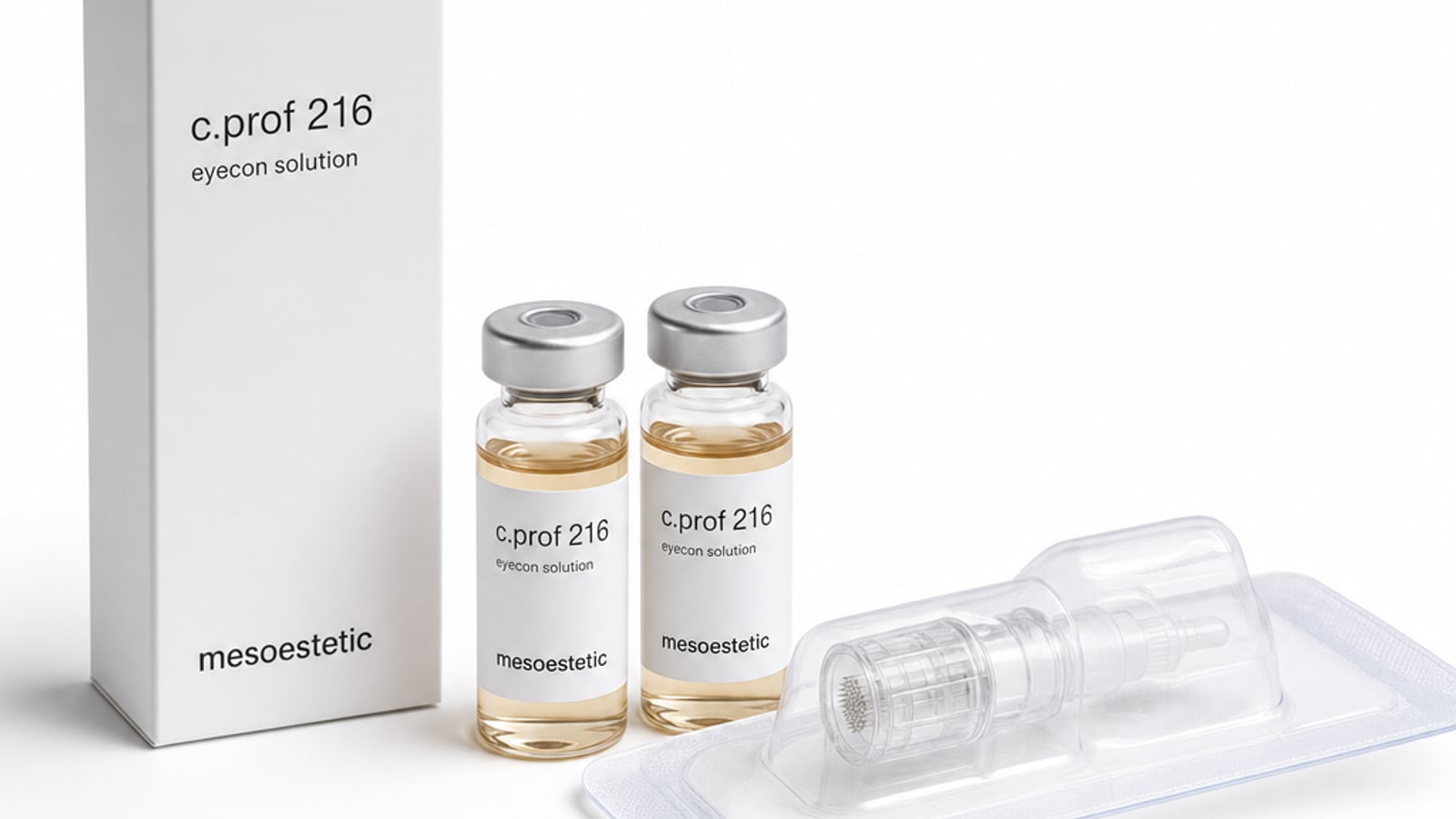
c.prof 216 eyecon solution — exosomes and PDRN for the eye contour in Baku
A Spanish solution from the c.prof mesoxome® line made specifically for the periorbital area: turmeric-derived plant exosomes paired with PDRN, tranexamic acid, vitamin K1 and rutin. Delivered by microneedling — nothing is injected into the eyelid.
Book a Treatment
Leave your contact details, and our specialist will contact you for a consultation and booking.
- ✅ Individual program selection
- ✅ Price clarification by areas
- ✅ Answers to all medical questions
By clicking 'Send', you consent to the processing of personal data in accordance with our privacy policy.
Overview
Paramedc.prof 216 eyecon solution is a product of the Spanish laboratory mesoestetic, part of the c.prof mesoxome® line and designed for the skin around the eyes. It is built on mesoxome® technology: plant exosomes — here from Curcuma longa — as carriers of signalling molecules, reinforced with PDRN (polynucleotides). Tranexamic acid, vitamin K1 and rutin complete the formula: three ingredients that address the two different mechanisms behind dark circles in the periorbital area, pigmentary and vascular. Supplied as 5 vials of 3 ml. Contraindications apply and a specialist consultation is required.
Benefits
Paramed- ✅ Lighter dark circles — both pigmentary and vascular
- ✅ Less puffiness and stasis in the periorbital area
- ✅ Works on fine lines and the quality of thin skin
- ✅ No injections into the eyelid — lower bruising risk
- ✅ Fits neatly into a protocol after facial laser or microneedling
- ✅ Short recovery: redness settles within hours
How it works
ParamedMake-up is removed, the skin cleansed and disinfected. The solution is applied to the periorbital area and driven through the skin with short-needle microneedling or a transepidermal delivery device — carefully, along the orbital rim, without crossing onto the mobile eyelid. The session takes 20–30 minutes including preparation and finishes with a soothing product and SPF. Redness usually settles within 2–3 hours.
Technology
ParamedWhat separates c.prof 216 from injectable exosomes is the route of delivery. This is a transepidermal solution: it is applied and driven through the skin with microneedling or a device-assisted delivery system rather than injected into the eyelid. Around the eye that matters — the skin here is under 0.5 mm thick, the vascular network is superficial and the bruising risk from injections is higher than on the cheek. The formula is periorbital by design: tranexamic acid suppresses melanogenesis and suits the pigmentary component of dark circles; vitamin K1 and rutin work on capillary permeability and venous stasis, the vascular component; PDRN handles regeneration and density in thin skin, while turmeric exosomes carry an anti-inflammatory, antioxidant signal.
- mesoestetic (Spain), c.prof mesoxome® line
- Curcuma longa exosomes — plant-derived vesicles
- PDRN — polynucleotides for regeneration
- Tranexamic acid — the pigmentary component of circles
- Vitamin K1 and rutin — the vascular component and puffiness
- Format 5 × 3 ml, transepidermal delivery
Preparation & aftercare
Paramed- Come without make-up or have it removed at the clinic
- No peels or active acids in the area for 3 days
- No alcohol for 24 hours — it worsens puffiness
- Remove contact lenses before the session
- Tell us about any history of herpes, allergies and chronic conditions
- No eye make-up for 12 hours
- Do not rub your eyes or use harsh products for 2–3 days
- SPF 30+ and sunglasses for at least a week
- Sauna, steam room and pool after 2–3 days
- Mild redness and tightness in the first hours are normal
FAQ
Paramed? Is this an injection under the eyes? ⌄
No. c.prof 216 is a transepidermal solution: it is driven through the skin with microneedling or a device-assisted delivery system. Nothing is injected into the eyelid, so the bruising risk is lower than with injectable protocols.
? What exactly does it do for dark circles? ⌄
It addresses two mechanisms: tranexamic acid the pigmentary one, vitamin K1 and rutin the vascular one and stasis. PDRN and exosomes handle regeneration and skin density. If the circles are shadows cast by fat pads or a tear trough, no formula helps — that is anatomy.
? How many sessions are needed? ⌄
Usually 4–6 at 1–2 week intervals, then maintenance every 2–3 months. The doctor sets the exact plan after examining the area.
? Can it be combined with facial treatments? ⌄
Yes — c.prof 216 most often runs as part of a wider protocol, after facial microneedling or a laser session. The doctor decides the sequence.
? Why is the price shown as “$$$”? ⌄
It depends on how much product a session uses, how long the course runs and whether the eye area is treated on its own or inside a facial protocol. We quote the exact price at the consultation.
Booking
ParamedBook a consultation — the doctor will work out what your dark circles are made of and say whether the c.prof 216 eyecon protocol will help.
Book a consultation →Exosomes — ExoCoBio, BENEV, Zishel, Promoitalia
ParamedCourse plan
ParamedUsually a course of 4–6 sessions at 1–2 week intervals, then maintenance every 2–3 months. The eye area responds more slowly than the face: puffiness improves as early as sessions 2–3, while tone and skin density are judged towards the end of the course. It is often combined with home care and, where the vascular pattern is pronounced, with laser work on vessels.
Comparison
ParamedInjectable exosomes (ExoCoBio ASCE+, BENEV, Purasomes) go deeper and hit harder on the face, but around the eyes injection is not always the better tool given skin thickness and vessels. PhilArt EYE, Rejuran I and TwAc Eyes polynucleotides are needle-delivered and address density in thin skin — a different level of intervention and a different price. Dermaheal Dark Circle Solution targets the same problem but without exosome technology. c.prof 216 makes sense when you want a gentle, regular protocol for dark circles and puffiness without loading the eyelid with injections. If the circles come from anatomy — fat pads and a tear trough — no solution will remove them, and the doctor will say so plainly.
Contraindications
Paramed- ⚠️ Pregnancy and breastfeeding
- ⚠️ Active herpes, conjunctivitis, a stye or eyelid inflammation
- ⚠️ Broken skin in the treatment area
- ⚠️ Active-phase autoimmune disease
- ⚠️ Oncological disease
- ⚠️ Allergy to the product's components
Why Paramed
ParamedThe eye area is where a course is easiest to sell and hardest to deliver on. At Paramed the doctor first works out what the circles are made of: pigment, vessels, the shadow of a fat pad, or simply poor sleep and dehydration. A cosmetology protocol addresses the first two; about the rest we are straightforward and, where needed, point you to a different solution. We work with the original mesoestetic line; the price for c.prof 216 is quoted at the consultation.
Our doctors
Certified specialists at Paramed

Aybeniz Mammedli
Dermatologist (MD)
2017 · Donetsk National Medical University · +1 cert.
Languages: Russian, Azerbaijani
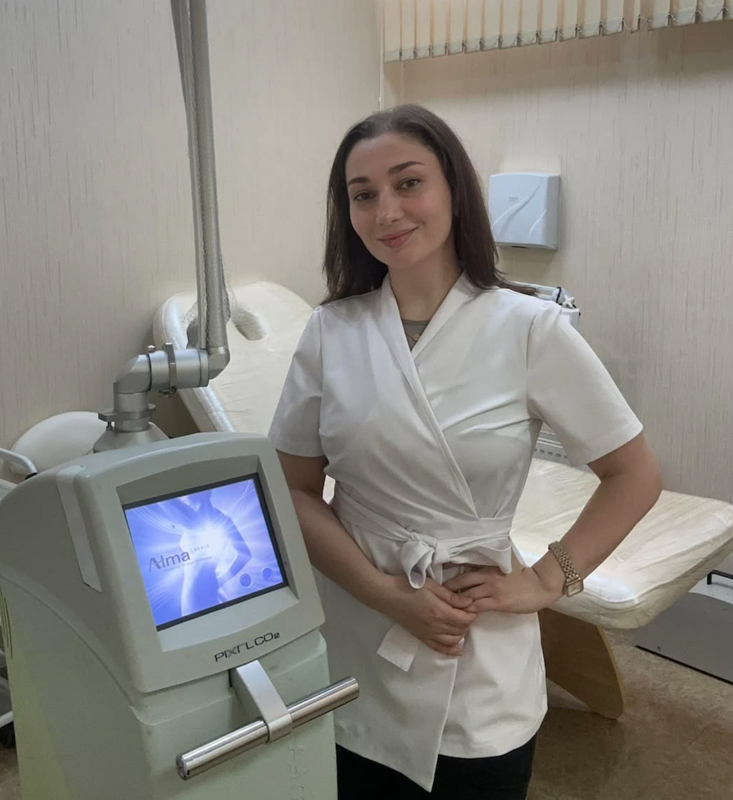
Simona Muradova
Cosmetologist (MD)
2019 · Yaroslavl Medical University · +1 cert.
Languages: Russian, Azerbaijani

Elvira Zakiyeva
Cosmetologist (MD)
15+ years' experience
2008 · Azerbaijan Medical University · +1 cert.
Languages: Russian, Azerbaijani